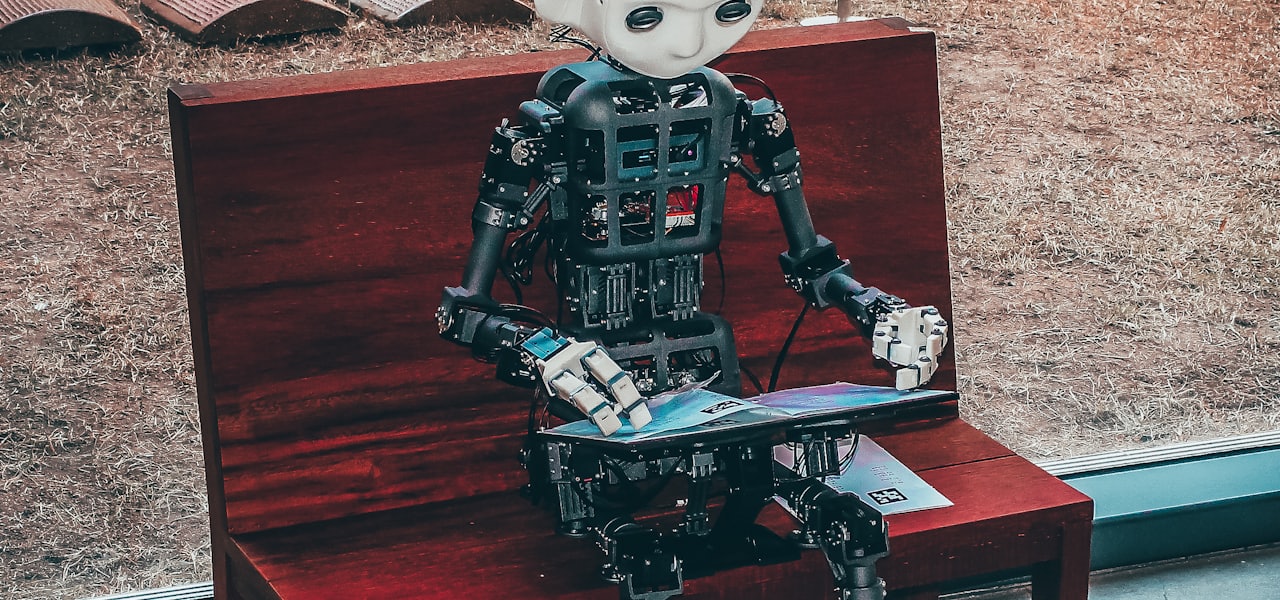
The Journal of Machine Learning Research is a peer-reviewed open access scientific journal covering machine learning. It was established in 2000 and the first editor-in-chief was Leslie Kaelbling. The current editors-in-chief are Francis Bach (Inria) and David Blei (Columbia University). == History == The journal was established as an open-access alternative to the journal Machine Learning. In 2001, forty editorial board members of Machine Learning resigned, saying that in the era of the Internet, it was detrimental for researchers to continue publishing their papers in expensive journals with pay-access archives. The open access model employed by the Journal of Machine Learning Research allows authors to publish articles for free and retain copyright, while archives are freely available online. Print editions of the journal were published by MIT Press until 2004 and by Microtome Publishing thereafter. From its inception, the journal received no revenue from the print edition and paid no subvention to MIT Press or Microtome Publishing. In response to the prohibitive costs of arranging workshop and conference proceedings publication with traditional academic publishing companies, the journal launched a proceedings publication arm in 2007 and now publishes proceedings for several leading machine learning conferences, including the International Conference on Machine Learning, COLT, AISTATS, and workshops held at the Conference on Neural Information Processing Systems.
Image translation
Image translation is the machine translation of images of printed text (posters, banners, menus, screenshots etc.). This is done by applying optical character recognition (OCR) technology to an image to extract any text contained in the image, and then have this text translated into a language of their choice, and the applying digital image processing on the original image to get the translated image with a new language. == General == Machine translation made available on the internet (web and mobile) is a notable advance in multilingual communication eliminating the need for an intermediary translator/interpreter, translating foreign texts still poses a problem to the user as they cannot be expected to be able to type the foreign text they wish to translate and understand. Manually entering the foreign text may prove to be a difficulty especially in cases where an unfamiliar alphabet is used from a script which user can't read, e.g. Cyrillic, Chinese, Japanese etc. for an English speaker or any speaker of a Latin-based language or vice versa. The technical advancements in OCR made it possible to recognize text from images. The possibility to use one's mobile device's camera to capture and extract printed text is also known as mobile OCR and was first introduced in Japanese manufactured mobile telephones in 2004. Using the handheld's camera one could take a picture of (a line of) text and have it extracted (digitalized) for further manipulation such as storing the information in their contacts list, as a web page address (URL) or text to use in an SMS/email message etc. Presently, mobile devices having a camera resolution of 2 megapixels or above with an auto-focus ability, often feature the text scanner service. Taking the text scanning facility one step further, image translation emerged, giving users the ability to capture text with their mobile phone's camera, extract the text, and have it translated in their own language. More and more applications emerged on this technology including Word Lens. After getting acquired by Google, it was made a part of Google Translate mobile app. Another simultaneous advancement in Image Processing, has also made it possible now to replace the text on the image with the translated text and create a new image altogether. == History == The development of the image translation service springs from the advances in OCR technology (miniaturization and reduction of memory resources consumed) enabling text scanning on mobile telephones. Among the first to announce mobile software capable of “reading” text using the mobile device's camera is International Wireless Inc. who in February 2003 released their “CheckPoint” and “WebPoint” applications. “CheckPoint” reads critical symbolic information on checks and is aimed at reducing losses that mobile merchants suffer from “bounced” checks by scanning the MICR number on the bottom of a check, while “WebPoint” enables the visual recognition and decoding of printed URL's, which are then opened by the device's web browser. The first commercial release of a mobile text scanner, however, took place in December 2004 when Vodafone and Sharp began selling the 902SH mobile which was the first to feature a 2 megapixel digital camera with optical zoom. Among the device's various multimedia features was the built-in text/bar code/QR code scanner. The text scanner function could handle up to 60 alphabetical characters simultaneously. The scanned text could be then sent as an email or SMS message, added as a dictionary entry or, in the case of scanned URLs, opened via the device's web browser. All subsequent Sharp mobiles feature the text scanner functionality. In September 2005, NEC Corporation and the Nara Institute of Science and Technology in Japan (NAIST) announced new software capable of transforming cameraphones into text scanners. The application differs substantially from similarly equipped mobile telephones in Japan (able to scan businesscards and small bits of text and use OCR to convert that to editable text or to URL addresses) by it ability to scan a whole page. The two companies, however, said they would not release the software commercially before the end of 2008. Combining the text scanner function with machine translation technology was first made by US company RantNetwork who in July 2007 started selling the Communilator, a machine translation application for mobile devices featuring the Image Translation functionality. Using the built-in camera, the mobile user could take a picture of some printed text, apply OCR to recognize the text and then translate it into any one of over 25 language available. In April 2008 Nokia showcased their Shoot-to-Translate application for the N73 model which is capable of taking a picture using the device's camera, extracting the text and then translating it. The application only offers Chinese to English translation, and does not handle large segments of text. Nokia said they are in the process of developing their Multiscanner product which, besides scanning text and business cards, would be able to translate between 52 languages. Again in April 2008, Korean company Unichal Inc. released their handheld Dixau text scanner capable of scanning and recognizing English text and then translating it into Korean using online translation tools such as Wikipedia or Google Translate. The device is connected to a PC or a laptop via the USB port. In February 2009, Bulgarian company Interlecta presented at the Mobile World Congress in Barcelona their mobile translator including image recognition and speech synthesis. The application handles all European languages along with Chinese, Japanese and Korean. The software connects to a server over the Internet to accomplish the image recognition and the translation. In May 2014, Google acquired Word Lens to improve the quality of visual and voice translation. It is able to scan text or picture with one's device and have it translated instantly. Since the OCR has been improving many companies or website started combining OCR and translation, to read the text from an image and show the translated text. In August 2018, an Indian company created ImageTranslate. It is able to read, translate and re-create the image in another language. As of late 2018, the tool added 13 new languages, including Arabic, Thai, Vietnamese, Hindi, and Bengali, significantly increasing its utility in Asia and the Middle East. This helps users translate photos already stored in their phone's gallery, not just live, real-time views. Currently, image translation is offered by the following companies: Google Translate app with camera ImageTranslate Yandex
Machine learning
Machine learning (ML) is a field of study in artificial intelligence concerned with the development and study of statistical algorithms that can learn from data and generalize to unseen data, and thus perform tasks without being explicitly programmed. Advances in the field of deep learning have allowed neural networks, a class of statistical algorithms, to surpass many previous machine learning approaches in performance. Statistics and mathematical optimisation methods compose the foundations of machine learning. Data mining is a related field of study, focusing on exploratory data analysis (EDA) through unsupervised learning. From a theoretical viewpoint, probably approximately correct learning provides a mathematical and statistical framework for describing machine learning. Most traditional machine learning and deep learning algorithms can be described as empirical risk minimisation under this framework. == History == The term machine learning was coined in 1959 by Arthur Samuel, an IBM employee and pioneer in the field of computer gaming and artificial intelligence. The synonym self-teaching computers was also used during this time period. The earliest machine learning program was introduced in the 1950s, when Samuel invented a computer program that calculated the chance of winning in checkers for each side, but the history of machine learning is rooted in decades of efforts to study human cognitive processes. In 1949, Canadian psychologist Donald Hebb published the book The Organization of Behavior, in which he introduced a theoretical neural structure formed by certain interactions among nerve cells. The Hebbian theory of neuron interaction set the groundwork for how many machine learning algorithms work, with connected artificial neurons changing the strength of their connections based on data. Other researchers who have studied human cognitive systems contributed to the modern machine learning technologies as well, including Walter Pitts and Warren McCulloch, who proposed the first mathematical model of neural networks including algorithms that mirror human thought processes. By the early 1960s, an experimental "learning machine" with punched tape memory, called Cybertron, had been developed by Raytheon Company to analyse sonar signals, electrocardiograms, and speech patterns using rudimentary reinforcement learning. It was repetitively "trained" by a human operator/teacher to recognise patterns and equipped with a "goof" button to cause it to reevaluate incorrect decisions. A representative book on research into machine learning during the 1960s was Nils Nilsson's book "Learning Machines", dealing mostly with machine learning for pattern classification. Interest related to pattern recognition continued into the 1970s, as described by Duda and Hart in 1973. In 1981, a report was given on using teaching strategies so that an artificial neural network learns to recognise 40 characters (26 letters, 10 digits, and 4 special symbols) from a computer terminal. Tom M. Mitchell provided a widely quoted, more formal definition of the algorithms studied in the machine learning field: "A computer program is said to learn from experience E with respect to some class of tasks T and performance measure P if its performance at tasks in T, as measured by P, improves with experience E." This definition of the tasks in which machine learning is concerned is fundamentally operational rather than defining the field in cognitive terms. This follows Alan Turing's proposal in his paper "Computing Machinery and Intelligence", in which the question, "Can machines think?", is replaced by asking whether machines can convincingly imitate a human in its responses to human-posed questions. In 2014 Ian Goodfellow and others introduced generative adversarial networks (GANs) which could produce realistic synthetic data. By 2016 AlphaGo had won against top human players in Go using reinforcement learning techniques. == Relationships to other fields == === Artificial intelligence === As a scientific endeavour, machine learning grew out of the quest for artificial intelligence (AI). In the early days of AI as an academic discipline, some researchers were interested in having machines learn from data. They attempted to approach the problem with various symbolic methods, as well as what were then termed "neural networks"; these were mostly perceptrons and other models that were later found to be reinventions of the generalised linear models of statistics. Probabilistic reasoning was also employed, especially in automated medical diagnosis. However, an increasing emphasis on the logical, knowledge-based approach caused a rift between AI and machine learning. Probabilistic systems were plagued by theoretical and practical problems of data acquisition and representation. By 1980, expert systems had come to dominate AI, and statistics was out of favour. Work on symbolic/knowledge-based learning continued within AI, leading to inductive logic programming (ILP), but the more statistical line of research was now outside the field of AI proper, in pattern recognition and information retrieval. Neural network research was abandoned by AI and computer science around the same time. This subfield, termed "connectionism", was continued by researchers from other disciplines, including John Hopfield, David Rumelhart, and Geoffrey Hinton. Their main success came in the mid-1980s with the reinvention of backpropagation. Machine learning (ML), reorganised and recognised as its own field, started to flourish in the 1990s. The field changed its goal from achieving artificial intelligence to tackling solvable problems of a practical nature. It shifted focus away from the symbolic approaches it had inherited from AI, and toward methods and models borrowed from statistics, fuzzy logic, and probability theory. === Data compression === === Data mining === Machine learning and data mining often employ the same methods and overlap significantly, but while machine learning focuses on prediction based on known properties learned from the training data, data mining focuses on the discovery of previously unknown properties in the data (this is the analysis step of knowledge discovery in databases). Data mining uses many machine learning methods, but with different goals; on the other hand, machine learning also employs data mining methods as "unsupervised learning" or as a preprocessing step to improve learner accuracy. Much of the confusion between these two research communities comes from the basic assumptions they work with: in machine learning, performance is usually evaluated with respect to the ability to reproduce known knowledge, while in knowledge discovery and data mining (KDD) the key task is the discovery of previously unknown knowledge. Evaluated with respect to known knowledge, an uninformed (unsupervised) method will easily be outperformed by other supervised methods, while in a typical KDD task, supervised methods cannot be used due to the unavailability of training data. Machine learning also has intimate ties to optimization: Many learning problems are formulated as minimisation of some loss function on a training set of examples. Loss functions express the discrepancy between the predictions of the model being trained and the actual problem instances (for example, in classification, one wants to assign a label to instances, and models are trained to correctly predict the preassigned labels of a set of examples). === Generalization === Characterizing the generalisation of various learning algorithms is an active topic of current research, especially for deep learning algorithms. === Statistics === Machine learning and statistics are closely related fields in terms of methods, but distinct in their principal goal: statistics draws population inferences from a sample, while machine learning finds generalisable predictive patterns. Conventional statistical analyses require the a priori selection of a model most suitable for the study data set. In addition, only significant or theoretically relevant variables based on previous experience are included for analysis. In contrast, machine learning is not built on a pre-structured model; rather, the data shape the model by detecting underlying patterns. The more variables (input) used to train the model, the more accurate the ultimate model will be. Leo Breiman distinguished two statistical modelling paradigms: the data model and the algorithmic model, wherein "algorithmic model" means more or less the machine learning algorithms like Random forest. Some statisticians have adopted methods from machine learning, producing the field of statistical learning. === Statistical physics === Analytical and computational techniques derived from deep-rooted physics of disordered systems can be extended to large-scale problems, including machine learning, e.g., to analyse the weight space of deep neural networks. Statistical physics is thus
Quantification (machine learning)
In machine learning, quantification (variously called learning to quantify, or supervised prevalence estimation, or class prior estimation) is the task of using supervised learning in order to train models (quantifiers) that estimate the relative frequencies (also known as prevalence values) of the classes of interest in a sample of unlabelled data items. For instance, in a sample of 100,000 unlabelled tweets known to express opinions about a certain political candidate, a quantifier may be used to estimate the percentage of these tweets which belong to class `Positive' (i.e., which manifest a positive stance towards this candidate), and to do the same for classes `Neutral' and `Negative'. Quantification may also be viewed as the task of training predictors that estimate a (discrete) probability distribution, i.e., that generate a predicted distribution that approximates the unknown true distribution of the items across the classes of interest. Quantification is different from classification, since the goal of classification is to predict the class labels of individual data items, while the goal of quantification it to predict the class prevalence values of sets of data items. Quantification is also different from regression, since in regression the training data items have real-valued labels, while in quantification the training data items have class labels. It has been shown in multiple research works that performing quantification by classifying all unlabelled instances and then counting the instances that have been attributed to each class (the 'classify and count' method) usually leads to suboptimal quantification accuracy. This suboptimality may be seen as a direct consequence of 'Vapnik's principle', which states: If you possess a restricted amount of information for solving some problem, try to solve the problem directly and never solve a more general problem as an intermediate step. It is possible that the available information is sufficient for a direct solution but is insufficient for solving a more general intermediate problem. In our case, the problem to be solved directly is quantification, while the more general intermediate problem is classification. As a result of the suboptimality of the 'classify and count' method, quantification has evolved as a task in its own right, different (in goals, methods, techniques, and evaluation measures) from classification. == Quantification tasks == === Quantification tasks according to the set of classes === The main variants of quantification, according to the characteristics of the set of classes used, are: Binary quantification, corresponding to the case in which there are only n = 2 {\displaystyle n=2} classes and each data item belongs to exactly one of them; Single-label multiclass quantification, corresponding to the case in which there are n > 2 {\displaystyle n>2} classes and each data item belongs to exactly one of them; Multi-label multiclass quantification, corresponding to the case in which there are n ≥ 2 {\displaystyle n\geq 2} classes and each data item can belong to zero, one, or several classes at the same time; Ordinal quantification, corresponding to the single-label multiclass case in which a total order is defined on the set of classes. Regression quantification, a task which stands to 'standard' quantification as regression stands to classification. Strictly speaking, this task is not a quantification task as defined above (since the individual items do not have class labels but are labelled by real values), but has enough commonalities with other quantification tasks to be considered one of them. Most known quantification methods address the binary case or the single-label multiclass case, and only few of them address the multi-label, ordinal, and regression cases. Binary-only methods include the Mixture Model (MM) method, the HDy method, SVM(KLD), and SVM(Q). Methods that can deal with both the binary case and the single-label multiclass case include probabilistic classify and count (PCC), adjusted classify and count (ACC), probabilistic adjusted classify and count (PACC), the Saerens-Latinne-Decaestecker EM-based method (SLD), and KDEy. Methods for multi-label quantification include regression-based quantification (RQ) and label powerset-based quantification (LPQ). Methods for the ordinal case include ordinal versions of the above-mentioned ACC, PACC, and SLD methods, and ordinal versions of the above-mentioned HDy method. Methods for the regression case include Regress and splice and Adjusted regress and sum. === Quantification tasks according to the type of data === Several subtasks of quantification may be identified according to the type of data involved. Example such tasks are: Quantification of networked data. This task consists of performing quantification when the datapoints are members of a relation, i.e., are interlinked. As such, this task is a strict relative of collective classification. Quantification over time. This task consists of performing quantification on sets that become available in a temporal sequence, i.e., as a data stream, and finds application in contexts in which class prevalence values must be monitored over time. == Evaluation measures for quantification == Several evaluation measures can be used for evaluating the error of a quantification method. Since quantification consists of generating a predicted probability distribution that estimates a true probability distribution, these evaluation measures are ones that compare two probability distributions. Most evaluation measures for quantification belong to the class of divergences. Evaluation measures for binary quantification, single-label multiclass quantification, and multi-label quantification, are Absolute Error Squared Error Relative Absolute Error Kullback–Leibler divergence Pearson Divergence Evaluation measures for ordinal quantification are Normalized Match Distance (a particular case of the Earth Mover's Distance) Root Normalized Order-Aware Distance == Applications == Quantification is of special interest in fields such as the social sciences, epidemiology, market research, allocating resources, and ecological modelling, since these fields are inherently concerned with aggregate data. However, quantification is also useful as a building block for solving other downstream tasks, such as improving the accuracy of classifiers on out-of-distribution data, measuring classifier bias and ranker bias, and estimating the accuracy of classifiers on out-of-distribution data. == Resources == LQ 2021: the 1st International Workshop on Learning to Quantify LQ 2022: the 2nd International Workshop on Learning to Quantify LQ 2023: the 3rd International Workshop on Learning to Quantify LQ 2024: the 4th International Workshop on Learning to Quantify LQ 2025: the 5th International Workshop on Learning to Quantify LeQua 2022: the 1st Data Challenge on Learning to Quantify LeQua 2024: the 2nd Data Challenge on Learning to Quantify QuaPy: An open-source Python-based software library for quantification QuantificationLib: A Python library for quantification and prevalence estimation
Argumentation framework
In artificial intelligence and related fields, an argumentation framework is a way to deal with contentious information and draw conclusions from it using formalized arguments. In an abstract argumentation framework, entry-level information is a set of abstract arguments that, for instance, represent data or a proposition. Conflicts between arguments are represented by a binary relation on the set of arguments. In concrete terms, an argumentation framework is represented with a directed graph such that the nodes are the arguments, and the arrows represent the attack relation. There exist some extensions of the Dung's framework, like the logic-based argumentation frameworks or the value-based argumentation frameworks. == Abstract argumentation frameworks == === Formal framework === Abstract argumentation frameworks, also called argumentation frameworks à la Dung, are defined formally as a pair: A set of abstract elements called arguments, denoted A {\displaystyle A} A binary relation on A {\displaystyle A} , called attack relation, denoted R {\displaystyle R} For instance, the argumentation system S = ⟨ A , R ⟩ {\displaystyle S=\langle A,R\rangle } with A = { a , b , c , d } {\displaystyle A=\{a,b,c,d\}} and R = { ( a , b ) , ( b , c ) , ( d , c ) } {\displaystyle R=\{(a,b),(b,c),(d,c)\}} contains four arguments ( a , b , c {\displaystyle a,b,c} and d {\displaystyle d} ) and three attacks ( a {\displaystyle a} attacks b {\displaystyle b} , b {\displaystyle b} attacks c {\displaystyle c} and d {\displaystyle d} attacks c {\displaystyle c} ). Dung defines some notions : an argument a ∈ A {\displaystyle a\in A} is acceptable with respect to E ⊆ A {\displaystyle E\subseteq A} if and only if E {\displaystyle E} defends a {\displaystyle a} , that is ∀ b ∈ A {\displaystyle \forall b\in A} such that ( b , a ) ∈ R , ∃ c ∈ E {\displaystyle (b,a)\in R,\exists c\in E} such that ( c , b ) ∈ R {\displaystyle (c,b)\in R} , a set of arguments E {\displaystyle E} is conflict-free if there is no attack between its arguments, formally : ∀ a , b ∈ E , ( a , b ) ∉ R {\displaystyle \forall a,b\in E,(a,b)\not \in R} , a set of arguments E {\displaystyle E} is admissible if and only if it is conflict-free and all its arguments are acceptable with respect to E {\displaystyle E} . === Different semantics of acceptance === ==== Extensions ==== To decide if an argument can be accepted or not, or if several arguments can be accepted together, Dung defines several semantics of acceptance that allows, given an argumentation system, sets of arguments (called extensions) to be computed. For instance, given S = ⟨ A , R ⟩ {\displaystyle S=\langle A,R\rangle } , E {\displaystyle E} is a complete extension of S {\displaystyle S} only if it is an admissible set and every acceptable argument with respect to E {\displaystyle E} belongs to E {\displaystyle E} , E {\displaystyle E} is a preferred extension of S {\displaystyle S} only if it is a maximal element (with respect to the set-theoretical inclusion) among the admissible sets with respect to S {\displaystyle S} , E {\displaystyle E} is a stable extension of S {\displaystyle S} only if it is a conflict-free set that attacks every argument that does not belong in E {\displaystyle E} (formally, ∀ a ∈ A ∖ E , ∃ b ∈ E {\displaystyle \forall a\in A\backslash E,\exists b\in E} such that ( b , a ) ∈ R {\displaystyle (b,a)\in R} , E {\displaystyle E} is the (unique) grounded extension of S {\displaystyle S} only if it is the smallest element (with respect to set inclusion) among the complete extensions of S {\displaystyle S} . There exists some inclusions between the sets of extensions built with these semantics : Every stable extension is preferred, Every preferred extension is complete, The grounded extension is complete, If the system is well-founded (there exists no infinite sequence a 0 , a 1 , … , a n , … {\displaystyle a_{0},a_{1},\dots ,a_{n},\dots } such that ∀ i > 0 , ( a i + 1 , a i ) ∈ R {\displaystyle \forall i>0,(a_{i+1},a_{i})\in R} ), all these semantics coincide—only one extension is grounded, stable, preferred, and complete. Some other semantics have been defined. One introduce the notation E x t σ ( S ) {\displaystyle Ext_{\sigma }(S)} to note the set of σ {\displaystyle \sigma } -extensions of the system S {\displaystyle S} . In the case of the system S {\displaystyle S} in the figure above, E x t σ ( S ) = { { a , d } } {\displaystyle Ext_{\sigma }(S)=\{\{a,d\}\}} for every Dung's semantic—the system is well-founded. That explains why the semantics coincide, and the accepted arguments are: a {\displaystyle a} and d {\displaystyle d} . ==== Labellings ==== Labellings are a more expressive way than extensions to express the acceptance of the arguments. Concretely, a labelling is a mapping that associates every argument with a label in (the argument is accepted), out (the argument is rejected), or undec (the argument is undefined—not accepted or refused). One can also note a labelling as a set of pairs ( a r g u m e n t , l a b e l ) {\displaystyle ({\mathit {argument}},{\mathit {label}})} . Such a mapping does not make sense without additional constraint. The notion of reinstatement labelling guarantees the sense of the mapping. L {\displaystyle L} is a reinstatement labelling on the system S = ⟨ A , R ⟩ {\displaystyle S=\langle A,R\rangle } if and only if : ∀ a ∈ A , L ( a ) = i n {\displaystyle \forall a\in A,L(a)={\mathit {in}}} if and only if ∀ b ∈ A {\displaystyle \forall b\in A} such that ( b , a ) ∈ R , L ( b ) = o u t {\displaystyle (b,a)\in R,L(b)={\mathit {out}}} ∀ a ∈ A , L ( a ) = o u t {\displaystyle \forall a\in A,L(a)={\mathit {out}}} if and only if ∃ b ∈ A {\displaystyle \exists b\in A} such that ( b , a ) ∈ R {\displaystyle (b,a)\in R} and L ( b ) = i n {\displaystyle L(b)={\mathit {in}}} ∀ a ∈ A , L ( a ) = u n d e c {\displaystyle \forall a\in A,L(a)={\mathit {undec}}} if and only if L ( a ) ≠ i n {\displaystyle L(a)\neq {\mathit {in}}} and L ( a ) ≠ o u t {\displaystyle L(a)\neq {\mathit {out}}} One can convert every extension into a reinstatement labelling: the arguments of the extension are in, those attacked by an argument of the extension are out, and the others are undec. Conversely, one can build an extension from a reinstatement labelling just by keeping the arguments in. Indeed, Caminada proved that the reinstatement labellings and the complete extensions can be mapped in a bijective way. Moreover, the other Datung's semantics can be associated to some particular sets of reinstatement labellings. Reinstatement labellings distinguish arguments not accepted because they are attacked by accepted arguments from undefined arguments—that is, those that are not defended cannot defend themselves. An argument is undec if it is attacked by at least another undec. If it is attacked only by arguments out, it must be in, and if it is attacked some argument in, then it is out. The unique reinstatement labelling that corresponds to the system S {\displaystyle S} above is L = { ( a , i n ) , ( b , o u t ) , ( c , o u t ) , ( d , i n ) } {\displaystyle L=\{(a,{\mathit {in}}),(b,{\mathit {out}}),(c,{\mathit {out}}),(d,{\mathit {in}})\}} . === Inference from an argumentation system === In the general case when several extensions are computed for a given semantic σ {\displaystyle \sigma } , the agent that reasons from the system can use several mechanisms to infer information: Credulous inference: the agent accepts an argument if it belongs to at least one of the σ {\displaystyle \sigma } -extensions—in which case, the agent risks accepting some arguments that are not acceptable together ( a {\displaystyle a} attacks b {\displaystyle b} , and a {\displaystyle a} and b {\displaystyle b} each belongs to an extension) Skeptical inference: the agent accepts an argument only if it belongs to every σ {\displaystyle \sigma } -extension. In this case, the agent risks deducing too little information (if the intersection of the extensions is empty or has a very small cardinal). For these two methods to infer information, one can identify the set of accepted arguments, respectively C r σ ( S ) {\displaystyle Cr_{\sigma }(S)} the set of the arguments credulously accepted under the semantic σ {\displaystyle \sigma } , and S c σ ( S ) {\displaystyle Sc_{\sigma }(S)} the set of arguments accepted skeptically under the semantic σ {\displaystyle \sigma } (the σ {\displaystyle \sigma } can be missed if there is no possible ambiguity about the semantic). Of course, when there is only one extension (for instance, when the system is well-founded), this problem is very simple: the agent accepts arguments of the unique extension and rejects others. The same reasoning can be done with labellings that correspond to the chosen semantic : an argument can be accepted if it is in for each labelling and refused if it is out for each labelling, the others being in an undecided state (the status of the arguments can remind the
Pray.com
Pray.com is a Christian social networking service and mobile application designed to facilitate religious communities. Launched in 2016, it was founded by Steve Gatena, Michael Lynn, Ryan Beck and Matthew Potter. The platform offers features for social networking, daily prayers, sermons, biblical content, and podcasts. The COVID-19 pandemic significantly increased Pray.com's user base, with downloads surging by 955%. During this period, the platform collaborated with churches to support virtual ministry services as in-person gatherings were restricted. The Federal Election Commission issued an opinion in 2021 that allows the platform to feature members of the United States Congress. Pray.com serves as a specialized social media platform for religious groups. Congregations can establish their own groups where members and leaders can participate in discussions, livestream services, and manage donations. Additionally, users can join "prayer communities" to post and respond to prayer requests. For those who subscribe to premium services, the platform provides access to biblically-inspired meditations and bedtime stories, and Bible stories for children. Pray.com also produces Radio drama-style productions with notable actors such as Kristen Bell and Blair Underwood narrating biblical stories. == History == === Funding and development === Pray.com has secured significant funding to support its development and growth. In 2017, the platform raised $2 million in seed funding from Science Inc., Greylock Partners, and Spark Capital. This was followed by a Series A funding round in March 2018, in which the company secured an additional $14 million from TPG Growth, Science Inc., and Greylock Partners. Founder Steve Gatena has highlighted difficulties in securing funding, noting some venture capitalists' negative attitudes towards faith-based technology. === Clinical studies === There have been clinical studies on Pray.com. In one study, the app was found to be acceptable and easy to use among racial and ethnic minority groups, with participants reporting improved mental health and well-being. Greater app use was associated with better outcomes, though low and variable usage suggests the need for further research to fully understand its impact. Another study examined Pray.com's impact on mental health by assigning 192 participants to use the app freely, use its meditative prayer function, or not use it at all. Over two months, participants reported overall improvements in mental health and well-being. Although no significant differences were found between groups, greater app usage correlated with better mental health outcomes. This suggests that religiously based mobile apps may help improve mental health and well-being. Another study of pray.com had similar findings. === National Day of Prayer === Pray first hosted a National Day of Prayer event in 2020 when it streamed to nearly one million viewers on Facebook. In 2021, Pray hosted a virtual event for the National Day of Prayer in the United States. The event featured remarks from public figures including United States President Joe Biden and former Vice President Mike Pence. President Biden spoke of his faith and prayed for an end to the COVID-19 pandemic. Biden remarked: "It means the world to me to know that there are people across the country who include Jill and me in their prayers. And I hope you know that you and your families are in our prayers as well. Today I am praying for the end of this great COVID crisis." The event featured musical performances from Gary Valenciano, Brooke Ligertwood from the Christian band Hillsong Worship, Lecrae, Heather Headley and Michael Neale. Other notable speakers included Ronnie Floyd, Ed Young, Mark Driscoll, and Samuel Rodriguez. Pray.com partnered with Sirius XM, DirecTV and Facebook to stream the event across multiple platforms. Pray.com was featured as a pop-up channel on Sirius XM, channel 154, to host the prayer event and celebrate people of all faith. === Partnerships and sponsorships === In 2024, Pray.com partnered with Sting Ray Robb as the primary sponsor for his No. 41 Chevrolet in the 2024 NTT IndyCar Series. The partnership, highlighting Robb's Christian faith, aims to engage younger audiences with faith-based content. The car, featuring Pray.com's branding, was set to debut at the Firestone Grand Prix of St. Petersburg. A partnership with Palantir Technologies for use of its AI systems was also announced in 2024. === Censorship in China === The app was removed from Apple's App Store in China as part of the country's broader efforts to restrict access to religious content. The app was targeted due to China's stringent regulations on religious material, particularly content distributed through digital platforms. The removal aligns with China's ongoing campaign to control online religious expression and maintain state-approved religious activities.
Kernel embedding of distributions
In machine learning, the kernel embedding of distributions (also called the kernel mean or mean map) comprises a class of nonparametric methods in which a probability distribution is represented as an element of a reproducing kernel Hilbert space (RKHS). A generalization of the individual data-point feature mapping done in classical kernel methods, the embedding of distributions into infinite-dimensional feature spaces can preserve all of the statistical features of arbitrary distributions, while allowing one to compare and manipulate distributions using Hilbert space operations such as inner products, distances, projections, linear transformations, and spectral analysis. This learning framework is very general and can be applied to distributions over any space Ω {\displaystyle \Omega } on which a sensible kernel function (measuring similarity between elements of Ω {\displaystyle \Omega } ) may be defined. For example, various kernels have been proposed for learning from data which are: vectors in R d {\displaystyle \mathbb {R} ^{d}} , discrete classes/categories, strings, graphs/networks, images, time series, manifolds, dynamical systems, and other structured objects. The theory behind kernel embeddings of distributions has been primarily developed by Alex Smola, Le Song, Arthur Gretton, and Bernhard Schölkopf. A review of recent works on kernel embedding of distributions can be found in. The analysis of distributions is fundamental in machine learning and statistics, and many algorithms in these fields rely on information theoretic approaches such as entropy, mutual information, or Kullback–Leibler divergence. However, to estimate these quantities, one must first either perform density estimation, or employ sophisticated space-partitioning/bias-correction strategies which are typically infeasible for high-dimensional data. Commonly, methods for modeling complex distributions rely on parametric assumptions that may be unfounded or computationally challenging (e.g. Gaussian mixture models), while nonparametric methods like kernel density estimation (Note: the smoothing kernels in this context have a different interpretation than the kernels discussed here) or characteristic function representation (via the Fourier transform of the distribution) break down in high-dimensional settings. Methods based on the kernel embedding of distributions sidestep these problems and also possess the following advantages: Data may be modeled without restrictive assumptions about the form of the distributions and relationships between variables Intermediate density estimation is not needed Practitioners may specify the properties of a distribution most relevant for their problem (incorporating prior knowledge via choice of the kernel) If a characteristic kernel is used, then the embedding can uniquely preserve all information about a distribution, while thanks to the kernel trick, computations on the potentially infinite-dimensional RKHS can be implemented in practice as simple Gram matrix operations Dimensionality-independent rates of convergence for the empirical kernel mean (estimated using samples from the distribution) to the kernel embedding of the true underlying distribution can be proven. Learning algorithms based on this framework exhibit good generalization ability and finite sample convergence, while often being simpler and more effective than information theoretic methods Thus, learning via the kernel embedding of distributions offers a principled drop-in replacement for information theoretic approaches and is a framework which not only subsumes many popular methods in machine learning and statistics as special cases, but also can lead to entirely new learning algorithms. == Definitions == Let X {\displaystyle X} denote a random variable with domain Ω {\displaystyle \Omega } and distribution P {\displaystyle P} . Given a symmetric, positive-definite kernel k : Ω × Ω → R {\displaystyle k:\Omega \times \Omega \rightarrow \mathbb {R} } the Moore–Aronszajn theorem asserts the existence of a unique RKHS H {\displaystyle {\mathcal {H}}} on Ω {\displaystyle \Omega } (a Hilbert space of functions f : Ω → R {\displaystyle f:\Omega \to \mathbb {R} } equipped with an inner product ⟨ ⋅ , ⋅ ⟩ H {\displaystyle \langle \cdot ,\cdot \rangle _{\mathcal {H}}} and a norm ‖ ⋅ ‖ H {\displaystyle \|\cdot \|_{\mathcal {H}}} ) for which k {\displaystyle k} is a reproducing kernel, i.e., in which the element k ( x , ⋅ ) {\displaystyle k(x,\cdot )} satisfies the reproducing property ⟨ f , k ( x , ⋅ ) ⟩ H = f ( x ) ∀ f ∈ H , ∀ x ∈ Ω . {\displaystyle \langle f,k(x,\cdot )\rangle _{\mathcal {H}}=f(x)\qquad \forall f\in {\mathcal {H}},\quad \forall x\in \Omega .} One may alternatively consider x ↦ k ( x , ⋅ ) {\displaystyle x\mapsto k(x,\cdot )} as an implicit feature mapping φ : Ω → H {\displaystyle \varphi :\Omega \rightarrow {\mathcal {H}}} (which is therefore also called the feature space), so that k ( x , x ′ ) = ⟨ φ ( x ) , φ ( x ′ ) ⟩ H {\displaystyle k(x,x')=\langle \varphi (x),\varphi (x')\rangle _{\mathcal {H}}} can be viewed as a measure of similarity between points x , x ′ ∈ Ω . {\displaystyle x,x'\in \Omega .} While the similarity measure is linear in the feature space, it may be highly nonlinear in the original space depending on the choice of kernel. === Kernel embedding === The kernel embedding of the distribution P {\displaystyle P} in H {\displaystyle {\mathcal {H}}} (also called the kernel mean or mean map) is given by: μ X := E [ k ( X , ⋅ ) ] = E [ φ ( X ) ] = ∫ Ω φ ( x ) d P ( x ) {\displaystyle \mu _{X}:=\mathbb {E} [k(X,\cdot )]=\mathbb {E} [\varphi (X)]=\int _{\Omega }\varphi (x)\ \mathrm {d} P(x)} If P {\displaystyle P} allows a square integrable density p {\displaystyle p} , then μ X = E k p {\displaystyle \mu _{X}={\mathcal {E}}_{k}p} , where E k {\displaystyle {\mathcal {E}}_{k}} is the Hilbert–Schmidt integral operator. A kernel is characteristic if the mean embedding μ : { family of distributions over Ω } → H {\displaystyle \mu :\{{\text{family of distributions over }}\Omega \}\to {\mathcal {H}}} is injective. Each distribution can thus be uniquely represented in the RKHS and all statistical features of distributions are preserved by the kernel embedding if a characteristic kernel is used. === Empirical kernel embedding === Given n {\displaystyle n} training examples { x 1 , … , x n } {\displaystyle \{x_{1},\ldots ,x_{n}\}} drawn independently and identically distributed (i.i.d.) from P , {\displaystyle P,} the kernel embedding of P {\displaystyle P} can be empirically estimated as μ ^ X = 1 n ∑ i = 1 n φ ( x i ) {\displaystyle {\widehat {\mu }}_{X}={\frac {1}{n}}\sum _{i=1}^{n}\varphi (x_{i})} === Joint distribution embedding === If Y {\displaystyle Y} denotes another random variable (for simplicity, assume the co-domain of Y {\displaystyle Y} is also Ω {\displaystyle \Omega } with the same kernel k {\displaystyle k} which satisfies ⟨ φ ( x ) ⊗ φ ( y ) , φ ( x ′ ) ⊗ φ ( y ′ ) ⟩ = k ( x , x ′ ) k ( y , y ′ ) {\displaystyle \langle \varphi (x)\otimes \varphi (y),\varphi (x')\otimes \varphi (y')\rangle =k(x,x')k(y,y')} ), then the joint distribution P ( x , y ) ) {\displaystyle P(x,y))} can be mapped into a tensor product feature space H ⊗ H {\displaystyle {\mathcal {H}}\otimes {\mathcal {H}}} via C X Y = E [ φ ( X ) ⊗ φ ( Y ) ] = ∫ Ω × Ω φ ( x ) ⊗ φ ( y ) d P ( x , y ) {\displaystyle {\mathcal {C}}_{XY}=\mathbb {E} [\varphi (X)\otimes \varphi (Y)]=\int _{\Omega \times \Omega }\varphi (x)\otimes \varphi (y)\ \mathrm {d} P(x,y)} By the equivalence between a tensor and a linear map, this joint embedding may be interpreted as an uncentered cross-covariance operator C X Y : H → H {\displaystyle {\mathcal {C}}_{XY}:{\mathcal {H}}\to {\mathcal {H}}} from which the cross-covariance of functions f , g ∈ H {\displaystyle f,g\in {\mathcal {H}}} can be computed as Cov ( f ( X ) , g ( Y ) ) := E [ f ( X ) g ( Y ) ] − E [ f ( X ) ] E [ g ( Y ) ] = ⟨ f , C X Y g ⟩ H = ⟨ f ⊗ g , C X Y ⟩ H ⊗ H {\displaystyle \operatorname {Cov} (f(X),g(Y)):=\mathbb {E} [f(X)g(Y)]-\mathbb {E} [f(X)]\mathbb {E} [g(Y)]=\langle f,{\mathcal {C}}_{XY}g\rangle _{\mathcal {H}}=\langle f\otimes g,{\mathcal {C}}_{XY}\rangle _{{\mathcal {H}}\otimes {\mathcal {H}}}} Given n {\displaystyle n} pairs of training examples { ( x 1 , y 1 ) , … , ( x n , y n ) } {\displaystyle \{(x_{1},y_{1}),\dots ,(x_{n},y_{n})\}} drawn i.i.d. from P {\displaystyle P} , we can also empirically estimate the joint distribution kernel embedding via C ^ X Y = 1 n ∑ i = 1 n φ ( x i ) ⊗ φ ( y i ) {\displaystyle {\widehat {\mathcal {C}}}_{XY}={\frac {1}{n}}\sum _{i=1}^{n}\varphi (x_{i})\otimes \varphi (y_{i})} === Conditional distribution embedding === Given a conditional distribution P ( y ∣ x ) , {\displaystyle P(y\mid x),} one can define the corresponding RKHS embedding as μ Y ∣ x = E [ φ ( Y ) ∣ X ] = ∫ Ω φ ( y ) d P ( y ∣ x ) {\displaystyle \mu _{Y\mid x}=\mathbb {E} [\varphi (Y)\mid X]=\int _{\Omega